- Construction process steps
Foundation treatment:
Clear away the debris in the foundation, and if there are any uneven areas, repair and level them in a timely manner.
Inspect and accept the foundation works to ensure that the surface is smooth and free of cracks, and the slope meets the standards (the longitudinal slope shall not exceed 1‰, and the transverse slope shall not exceed 1%).
Survey and setting-out:
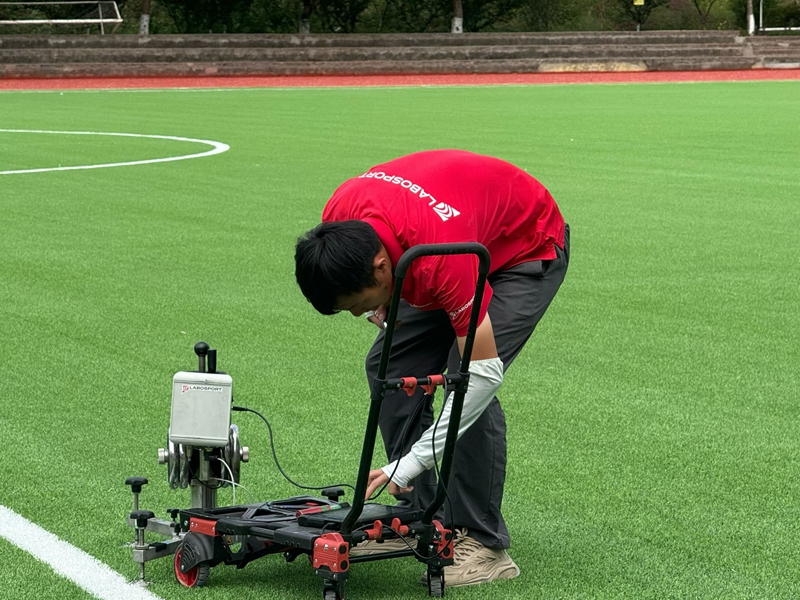
Based on the design drawings, tools such as theodolites and steel tape measures are used for measurement and setting out to determine the center point of the site, the center of the semi-circle, and the positions of various functional lines.
After setting out, the angle part is verified using radiating line length, and the straight line part is rechecked using a calibrated steel ruler to ensure compliance with standards.
Lawn paving:
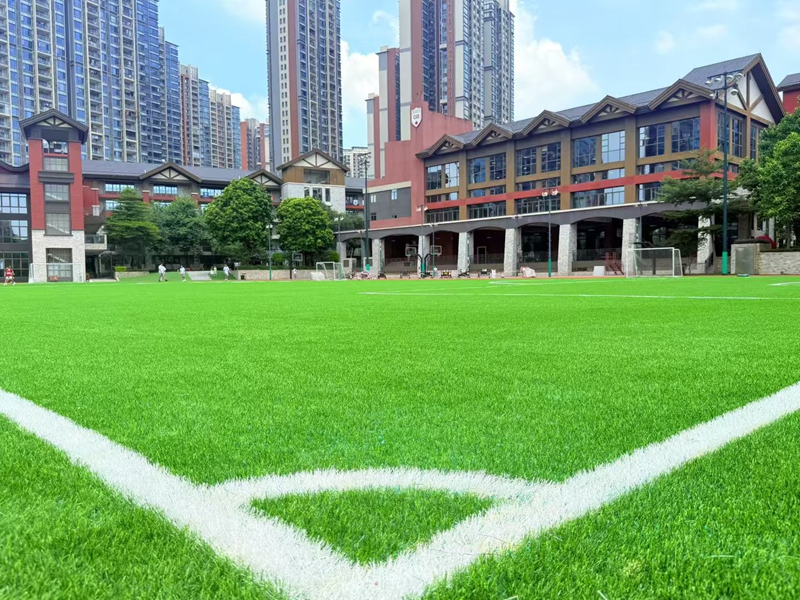
Lay the turf on the non-woven fabric according to the original factory specifications, ensuring a 3-8mm overlap between the turf pieces.
Use a dedicated cutting tool to trim and align the edges of the lawn, ensuring that the seam is no more than 3mm.
Place seam fabric under the cutting area, apply turf-specific glue on the joint surface, and after it dries to the touch, join and firmly tap it into place.
Lawn paving:
Lay the turf on the non-woven fabric according to the original factory specifications, ensuring a 3-8mm overlap between the turf pieces.
Use a dedicated cutting tool to trim and align the edges of the lawn, ensuring that the seam is no more than 3mm.
Place seam fabric under the cutting area, apply turf-specific glue on the joint surface, and after it dries to the touch, join and firmly tap it into place.
Lawn fixation:
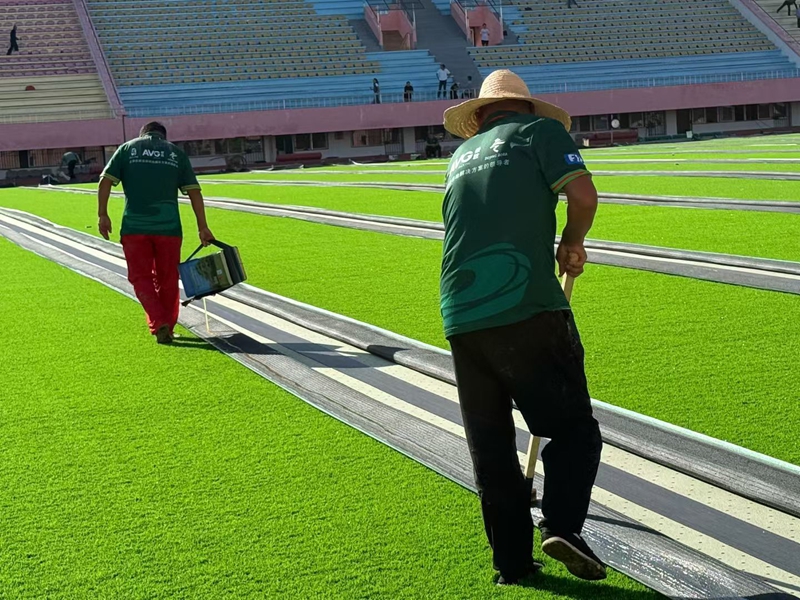
Clean the bottom surface of the lawn, non-woven fabric, and interface fabric that need to be bonded, ensuring the surface is dry and free of moisture.
The construction should be carried out when the ambient temperature is above 5℃, and it is not advisable to conduct construction during rainy or overcast weather.
After applying the glue, let it dry for 10-30 minutes until the glue is about 80-90% dry. Align and stick it firmly in one go, and do not move it back and forth.
After bonding, use a rubber hammer to firmly tap from the bonding area to both sides, ensuring that the surface is fully and tightly bonded.
Fill with quartz sand and rubber particles:
Sand filling process: Fill the grass seedlings with round-shaped sand particles, and use quartz sand to secure the seedlings so that they do not fall over. Fill the sand until the remaining height of the seedlings is within 1 cm.
Rubber particles should be evenly spread, and angular sand particles should not be poured between the grass seedlings.
When laying quartz sand, it is necessary to check for flatness and sufficiency. Any deficiencies should be appropriately supplemented.
After the quartz sand paving is completed, a hard-bristled brush should be used to sweep back and forth to ensure the quartz sand falls densely and evenly.

Construction precautions
Environmental requirements:
The temperature for construction should be between 0-40℃, and it is not advisable to carry out construction during rainy and humid weather.
The mobilization of materials should be conducted within an appropriate time frame, and construction machinery needs to undergo enhanced maintenance to minimize the impact of noise and exhaust gas on the environment.
Material requirements:
The quartz sand is required to have a roundness of over 80% and a diameter ranging from 0.2 to 1.5mm.
The glue should be applied evenly, and repeated application is not allowed, as it may cause bubbling.